Paws & Pastries: Merge Café
- 3.6
- Rating
- 10.00K
- Installs
- Free
- Price

 Analysis by App-foxy
I spent time with Paws & Pastries: Merge Café as a light, character-driven casual game, and its central idea is easy to understand: combine items, improve a café, help animals, and follow a romantic storyline. That mix gives it a warmer personality than a purely score-based merge game. It feels aimed at players who enjoy gentle progress, decorating or building toward a personal space, and story moments that give each task a little more meaning.
The game is made by TreesPlease Games Ltd and is free to start. That matters because the main question is not whether you must pay before trying it, but how comfortable you are with a free game that offers optional purchases. The listed purchase range runs from $0.99 to $99.99 per item, so the experience can suit a casual player who spends nothing, while also requiring some restraint from anyone tempted by larger bundles. I would approach it as a free trial of the full loop rather than assuming that every part of the café can be enjoyed at the same pace without spending.
How the café loop feels in everyday play
I judge a merge game by how well its routine fits into the gaps in my day, not just by how charming its theme looks at first. Here, I’d use a short visit to decide which item chain deserves board space before making a bigger commitment to a goal. That small planning habit makes the café loop easier to assess, and it leads naturally to the question of how progress feels when patience and spending come into play.
You May Also Like

 AccuWeather: Weather Radar
AccuWeather Review: A Quick, Clear Forecast for Everyday Decisions
For everyday plans, the best forecast is the one you can understand quickly. AccuWeather makes rain timing, radar, and local conditions easy to act on, with a few trade-offs.

 Hill Climb Racing
Why Hill Climb Racing Still Turns Crashes Into One More Run
A tiny car, a bumpy hill and one more upgrade: Hill Climb Racing keeps resurfacing because its simple chaos makes every near-miss feel personal.

 AliExpress - Shopping App
AliExpress Makes Global Shopping Feel Personal, but Shoppers Bear the Risk
AliExpress turns a global marketplace into a pocket-sized discovery engine. Its reach is useful, its shopping loop compelling, and its trade-offs easy to miss.

 Lords Mobile: Kingdom Wars
Lords Mobile Is a Kingdom-Building Routine, Not a Quick Match
A case-by-case verdict on the building, battles, device demands, and social commitments that make Lords Mobile rewarding for some players and exhausting for others.

 PDF Scanner app - TapScanner
TapScanner Makes Paperwork Easier to Capture, Check, and Share
TapScanner makes scanning with a phone feel less like a rescue operation and more like a dependable step in getting work done. Its capture tools are useful, though not flawless.

 Block Blast!
 Shows How Much a Puzzle Game Can Leave Out
A quiet grid game shows why puzzle players increasingly value instant clarity, repeatable skill and low-pressure play—and where the genre still needs to catch up.
More From Our News Desk
View All News


A simple merge foundation with a more personal setting
The café setting gives the familiar merge structure a clear purpose. Instead of combining objects only to chase a higher score, I am working toward a place that is meant to feel like my own project. The animal-rescue angle adds another reason to keep going, while the romance element gives the broader progression a social and emotional thread. Those three themes—café design, animal care, and relationships—are what make this particular game easier to remember than a bare merge board.
In practice, I found the appeal strongest in short sessions. A typical use case is opening the game during a break, making a few useful combinations, checking what the café needs next, and stopping before the activity starts to feel repetitive. That rhythm suits the casual category well. It does not demand the same commitment as a deep role-playing game, and it is more directed than a completely open-ended decorating app because the goals give me a reason to choose one action over another.
The best way to approach the board is to treat every empty space as valuable. Merge games can become uncomfortable when the player creates too many low-level objects without a plan. I found it more satisfying to pause before combining items and ask which chain is currently blocking progress. Clearing a crowded corner may be more useful than immediately making the largest available merge, especially when the board needs room for the next objective.
Why the story changes the value of small tasks
The romance and rescue themes are not just decorative labels in the concept. They change how I interpret the routine work. A café upgrade feels like part of a continuing project, and an animal-related goal gives the next merge a more visible emotional reason. Players who enjoy light narrative motivation will probably get more from this structure than players who want nothing but fast combinations and high scores.
That story-led approach also creates a trade-off. If I am mainly interested in designing a café, story interruptions may feel slower than expected. If I am mainly looking for romance, the merge work may seem like a barrier between narrative moments. The game is most convincing when I enjoy all three parts together. It is less suitable when one element is the only reason I am installing it.
Practical habits that make the board easier to manage
One useful habit is to keep a small reserve of related items instead of merging everything immediately. This gives me flexibility when a task asks for a particular stage in a chain. Another is to avoid filling the board with objects that have no obvious short-term purpose. In a merge game, “more progress” is not always the same as “more objects”; a tidy board can be a strategic advantage.
I also recommend deciding what kind of session I want before starting. If I have only a few minutes, I focus on clearing space and completing the nearest manageable goal. If I have longer, I can work through several combinations and pay more attention to the café’s visual development or the story. This small distinction prevents the game from feeling like a list of chores and makes its freeform elements easier to enjoy.
Cost, access, and what free really means here
The game itself is free, which makes it easy to test whether the combination of merging, café design, animal rescue, and romance works for me. I do not need to commit money just to discover whether the tone suits my taste. That is the strongest part of its value proposition: the entry cost is low, while the core appeal can be judged through actual play.
Optional purchases range from $0.99 to $99.99 per item. I would therefore set a personal spending limit before playing, particularly if I am prone to paying for convenience during a slow section. The lower-priced option may feel reasonable for a small boost, but the existence of a much higher-priced item means I would not describe the game as automatically inexpensive simply because it is free to download.
For me, the right question is whether I enjoy the ordinary pace without treating purchases as necessary. If the answer is yes, the free access has real value. If I feel pushed to buy in order to maintain interest or keep the café moving at a comfortable speed, the value drops quickly. That judgment is personal, but it is important because the game’s enjoyment depends on patience as much as on its theme.
Where the experience can lose momentum
The biggest limitation is the possibility of repetition. Combining items is calming when I am in the mood for it, but the same loop can become mechanical if I want constant novelty. The café and story themes help, yet they do not completely remove the need to perform similar actions repeatedly. I would not choose this as my main game if I need rapid action, complex strategy, or a constantly changing challenge.
There is also a tension between the cozy presentation and the purchase range. A relaxed game can make optional spending feel harmless, especially when a small shortcut appears to solve an immediate inconvenience. I prefer to let progress happen naturally and view purchases as a choice rather than part of the expected routine. Players who dislike any form of monetized acceleration may find that the free model affects their enjoyment even when they never spend.
The average rating is 3.6 from around 95 ratings, with around 35 written reviews, and the game has passed 10K installs. I read those numbers as a sign of an early, still-developing audience rather than as proof that it will suit everyone. The response is not overwhelmingly positive, so I would keep expectations measured and use the free access to make my own decision instead of relying on popularity alone.
Device and audience considerations
The content rating is Everyone, which fits the approachable tone and makes it a reasonable option for a broad audience. I would still consider the individual player’s tolerance for merge repetition and optional purchases, because age suitability does not automatically mean the design will be enjoyable for every family member.
The listed minimum operating-system requirement is version 9, and the current version is 1.7.2. That gives Android users a useful compatibility checkpoint before installing. I would also keep the game updated when possible, since a title built around ongoing progression benefits from using its current version rather than judging an older build.
Who will get the most from it
I think the strongest audience is someone who wants a low-pressure mobile game with a clear theme. If I like café makeovers, cute animal-focused goals, and romance stories, the combination gives me several reasons to return. It also works for players who prefer progress in small pieces instead of long sessions. The game is easy to imagine as a quiet evening activity or a short break between other tasks.
It is particularly suitable for a player who enjoys planning space on a merge board. Keeping chains organized, choosing when to combine, and protecting room for future tasks provide more satisfaction than simply tapping through every available action. That is one of the less obvious strengths: the game can reward restraint. I get more control when I think ahead, even though the surface presentation remains friendly and uncomplicated.
I would be more cautious about recommending it to someone who wants a fully featured café-management simulation. The concept suggests a café, but the experience is built around casual merging and themed progression rather than the detailed operational decisions found in a dedicated management game. Likewise, a player searching for a serious romance narrative may find the merge structure too prominent. The game works best as a blend, not as a specialist title in any one of those areas.
How it compares with familiar alternatives
Compared with a standard match or merge game with no story, this one has a stronger sense of place. The café gives combinations a visible destination, while animal rescue and romance add context to progress. That makes it a better choice for me when I want emotional framing around simple tasks.
Compared with a traditional café simulator, it is likely to feel lighter and less managerial. I would choose a dedicated simulator if I wanted detailed menus, staffing decisions, or economic planning. Here, the attraction is the combination of a welcoming setting and accessible merging, not the depth of running a business.
Compared with a pure romance game, the experience asks for more active participation between story moments. That can be a benefit when I want something to do rather than just read, but it can also frustrate me if the narrative is my only priority. The right alternative depends on whether I want the story to lead or the merge board to lead.
My recommendation after weighing the trade-offs
I would recommend trying it without spending first. The free entry makes that an easy decision, and the game has a distinct enough combination of café design, animal rescue, and romance to justify a look. I would play several ordinary sessions rather than judging it from the first few minutes, because its value comes from seeing whether the routine remains pleasant once the initial charm settles.
My personal rule would be simple: spend only if the free progression already feels enjoyable. A purchase should improve a game I am happy to play, not rescue a loop I find tedious. With items priced from $0.99 up to $99.99, that rule is especially useful here. The game can offer good free entertainment, but its paid value depends entirely on how much convenience or continued engagement I personally want.
In the end, Paws & Pastries: Merge Café is a good fit for patient casual players who like a cozy setting with more than one kind of motivation. I enjoy the way the café, rescue work, and romance give ordinary merges a sense of direction. I would skip it if I wanted fast action, deep business simulation, or a story without repeated board work. For everyone else, the smartest way to judge its value is to treat the free version as the real test: keep the board organized, resist rushing into purchases, and see whether building this particular café feels rewarding at your own pace.
FAQs for Paws & Pastries: Merge Café
01What is Paws & Pastries: Merge Café about?
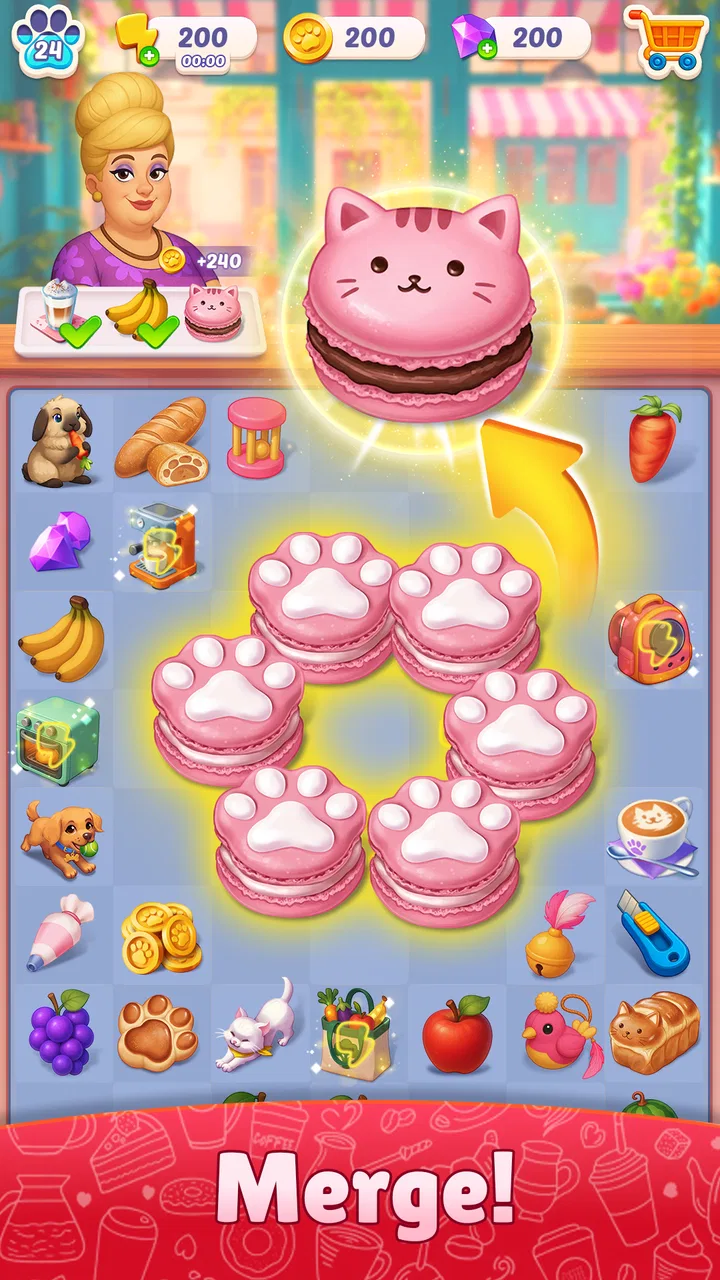
Paws & Pastries: Merge Café is a relaxing merge-and-management game centered on running a charming café for animal customers. You combine matching ingredients and objects to create upgraded items, complete orders, improve the café, and gradually unlock new areas and story content. Its cute presentation and straightforward mechanics make it suitable for players who enjoy casual games with light progression.
02How does the merging gameplay work?
The main gameplay involves combining two or more matching items on the café board to produce a higher-level ingredient, dish, or useful object. These items can then be used to fulfill customer requests and complete objectives. The board can become crowded, so planning your merges is important. Players should avoid combining everything immediately and leave enough space for new items and future tasks.
03Is Paws & Pastries: Merge Café free to download and play?
The game can generally be downloaded and played without an upfront purchase, but it may include optional in-app purchases. These purchases can provide extra energy, currency, boosters, or other convenience features. Progress is usually possible without spending money, although free players may need to wait for energy to refill or accept a slower pace. Check the store listing for current pricing and purchase details.
04Does the game require an internet connection?
Some parts of Paws & Pastries: Merge Café may work without a constant connection, particularly basic merging activities that have already loaded. However, an internet connection may be needed for advertisements, cloud synchronization, events, updates, account features, and purchases. Offline behavior can vary by device and game version, so players who plan to play while traveling should test the app before relying on it without Wi-Fi or mobile data.
05Is Paws & Pastries: Merge Café suitable for children?
The game’s colorful art style, friendly animal characters, and simple controls make it approachable for younger players, but parents should still review the available settings and store information. Because the game may contain advertisements, optional purchases, and online features, parental supervision is recommended. Children may also encounter energy systems or timed rewards that encourage returning to the game frequently.
Pros
- Relaxing merge gameplay that's easy to learn and enjoy in short sessions.
- Charming café theme with appealing pastries
- décor
- and animal characters.
- Steady progression keeps new recipes
- areas
- and upgrades coming.
- Story elements give the café tasks more purpose than simple merging.
- Suitable for casual players who prefer a gentle
- non-competitive experience.
Cons
- Energy limits can interrupt longer play sessions.
- Some upgrades and progress may require considerable waiting.
- Random merge pieces can make completing specific orders frustrating.
- Optional purchases may speed up progress or provide extra resources.
- The gameplay loop can feel repetitive after extended sessions.

Paws & Pastries: Merge Café
Gallery